Tuesday, April 26, 2011

Cash is king: 8 tips for optimizing your startup financing strategy - Fortune Finance

Cash is king: 8 tips for optimizing your startup financing strategy - Fortune Finance

Cash is king: 8 tips for optimizing your startup financing strategy


How startup CEOs can optimize their funding strategies and avoid the common cash management pitfalls.

By David Skok, contributor

All smart CEO's know that they need to focus on building a compelling product, hiring a great team, maximizing sales and making their customers happy. For many first-time CEO's, focusing on these extremely important topics may distract them from another very important task: ensuring that the company can continue to raise funding at ever increasing valuations.

In practice this means that CEO's should:

  • Make sure that they understand when their cash runs out
  • Understand what milestones have to be achieved to get a higher valuation
  • Create the right plan to achieve those milestones in the right timeframe

Managing to your cash out date introduces some very strict time deadlines into the equation, and requires you to examine which specific milestones you plan to achieve before that date.

1. Understand how startups are valued.

To understand why milestones are so important, let's take a look at how startup valuations change over time. First time entrepreneurs should be forgiven for thinking that their valuation will just increase linearly over time since their last round. After all, they have been putting in a ton of late nights and weekends working to make progress. However in practice, things typically don't work that way:
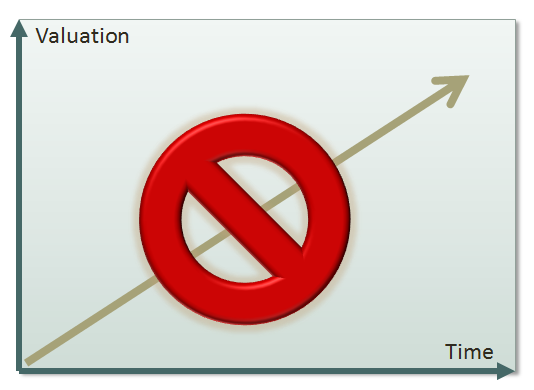
image

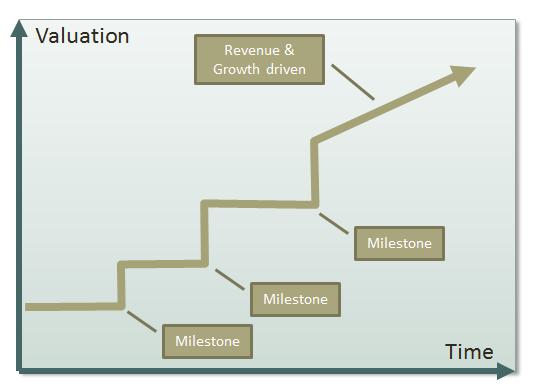
Like other investments, startup valuations are based on a calculation of risk and reward. Valuations increase as the level of risk goes down (or as the size of the perceived eventual reward goes up). In practice, risk is not reduced linearly over time, but instead changes in big increments when particular milestones are reached. These milestones could be things like customer traction, the hiring of a strong management team or, in the case of an Internet business, when a monetization strategy is proven to work.
image

Usually the single biggest way to show that risk is being reduced is to show evidence of increasing traction with paying customers. If a significant number of customers are willing to pay for a product, that tells an investor many positive things:

  • The company has reached product/market fit
  • The monetization strategy is working
  • The technology works
  • The team has shown some ability to execute

However this can be a hard milestone to reach on one round of funding, so investors will look for intermediate milestones that help to tell them that risk is being reduced. Here are some steps along the way to full customer traction that increasingly de-risk a startup:

  1. You have shown a wireframe mockup of the application to a significant number of customers and they are willing to talk to investors and tell them that they plan to buy the product when it ships.
  2. You have shipped a beta of the product to some customers
  3. Your beta customers are testing the product and reporting success
  4. You have a large number of free users, and their engagement with the product is high
  5. You have sold the product to a small number of paying customers
  6. Your paying customers have put the product into production usage, and are reporting success
  7. Your customers are coming back and re-ordering, and recommending the product to their friends

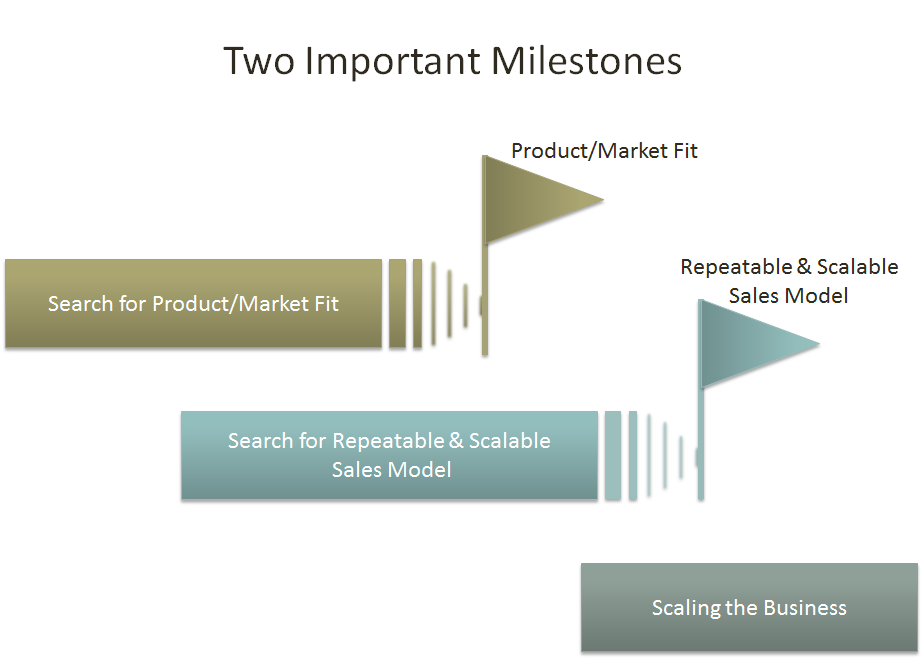
Readers of one of my earlier blog posts, Setting the Startup Accelerator Pedal, will know that I like to think of the lifecycle of a startup in three phases. The first phase is the search for product/market fit. Increasing customer traction is the best way to prove to investors that you have reached product/market fit. The second phase is the search for a repeatable and scalable sales model. Reaching this milestone will greatly increase valuation and attract growth stage investors who like to invest in companies that are ready to scale.
image

Once a startup enters the third phase -- scaling the business, it will usually start to see its valuation increase linearly as a multiple of revenues or profitability.

Other milestones that impact valuation are:

  • Hiring a great CEO with a proven track record
  • Hiring a strong management team
  • Reaching profitability
  • Becoming the clear market leader

2. Identify your specific risks

In the early days of a startup, the nature of the risks can vary greatly from one startup to the next. For example, if your startup is promising to deliver a new battery for electric cars that can hold 10x more energy, there is little risk that you will be able to sell the battery. Usually with this kind of startup, the major risk is whether the technology will work.

Another startup might have significant execution risk, and their valuation might increase if they are able to hire proven A player executives that have a track record of great execution. For example, if a company is started by a strong business founder, but requires great software to be developed, that startup would become both more likely to get funding, and a higher valuation, if the business founder were able to attract a proven technical co-founder.

Another type of startup might have shown great customer traction for its free product, but not yet have proven that it can figure out how to charge those customers. (e.g., the early days of Google, Twitter and Facebook.) Proving that it can monetize effectively would increase valuation.

Other startup risks include:

  • Team: unproven team. Not clear if they can execute.
  • Competitive: crowded marketplace with significant competitors
  • Market timing: you're confident about the long term market prospects, but it is not clear when the market will take off.

3. Look for quick ways to litigate risks before fundraising

If your company is about to raise funding, and you have very little time available, there are likely some quick steps you can take to decrease investor risk, and therefore increase your chances of success, plus get a higher valuation.

  • The best example of this would be a company looking to raise a Seed or Series A round. Even in this early stage of the business, any proof of customer traction can greatly de-risk your startup and increase valuation. This could be accomplished by sketching wireframes of the application, and showing them to customers. The goal would be to get enough customers to validate that this meets a real need so that they are keen to start using it as soon as it ships, and willing to pay for it. If you were able to walk into an investor meeting with a list of 20 customer that were willing to talk to investors, or had provided you with a written statement to that effect, your chances of getting funded would go up substantially, and your valuation would likely increase.
  • In our battery example above, the major risk was technical. A quick way to mitigate the risk (but not totally eliminate it), would be to get the top technical expert in the particular area of science to take a look at the scientific problem you were aiming to solve, and have them render an opinion that this technical approach should work.

4. Either aise enough cash to match the milestones...

When raising a round of funding, identify the next target milestone that you'd like to reach to significantly de-risk the business. Reaching this will enable you to raise an up-round (up-round = round raised at a higher valuation than the post-money of your previous round).

As an example, let's say you have just raised your Seed or Series A round. Your next most important milestone will be ship the product and get enough customers using the product to start to demonstrate evidence that you have product/market fit. The more customers the better, and if they are paying, that is even better.

Once you have identified that milestone, do some hard thinking on how long it will take you to reach that point with some conservatism built in. Then add three months of cushion for the time it will take to meet with investors to get the next round raised.

Knowing that time frame will allow you to figure out how much money to raise.

Remember, company success is far more important than dilution. A common mistake that entrepreneurs make is to focus too heavily on avoiding dilution by raising less money. Another common problem is failure to build in enough cushion for the unexpected. It's pretty common for product development to take longer than planned, or for sales to take longer to ramp than hoped. Raising more cash to provide a cushion is often a very smart way to decrease overall dilution, as it will allow you to optimize the subsequent round.

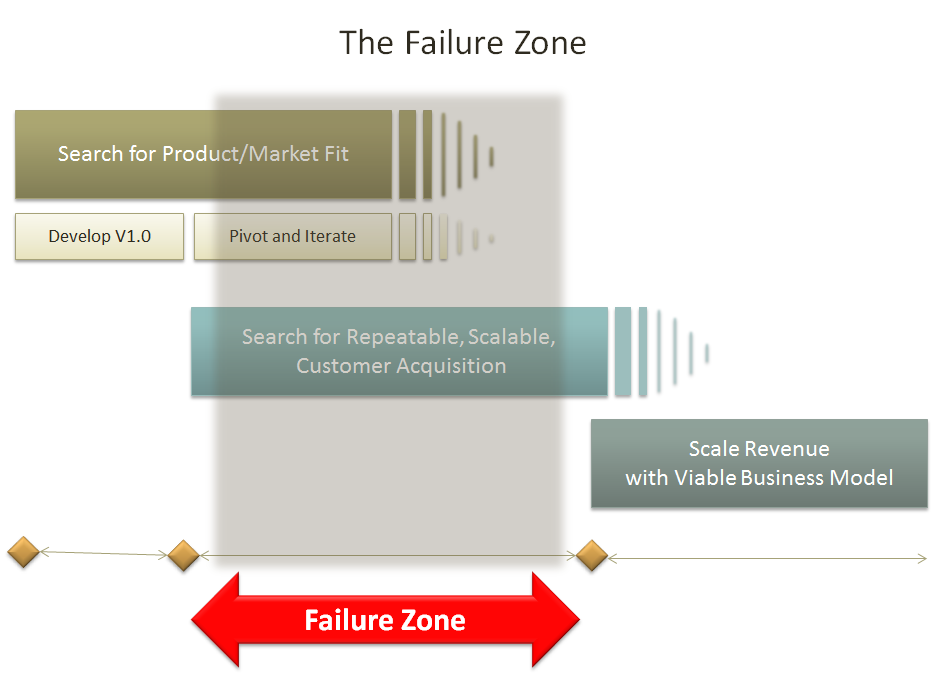
The diagram below shows where most startups fail. If you are financing to get through this zone and have any level of concern, it pays to take more cash.
image

5. ... or match your milestones to available cash

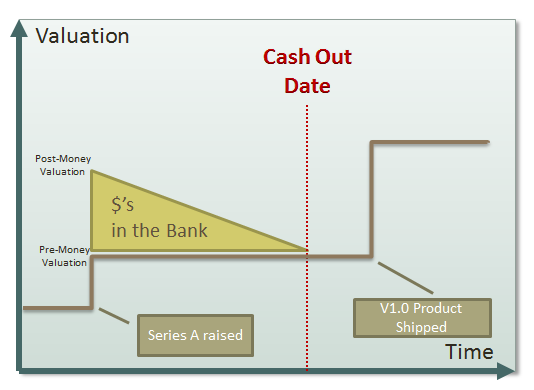
If you have already raised cash, you will want to figure out what milestones could be reached before you hit your cash out date. You may well find that your current strategy is targeting a milestone that cannot be completely achieved with the cash you have in hand. If that is the case, you could be setting yourself up for a down round.

The best strategy here is to do one of two things:

  1. Reduce your burn rate to allow you to complete the milestone before you run out of cash.
  2. Pick a different intermediate milestone, and ask investors if reaching that will allow you to successfully raise an up-round.

As an example of #2, let's go back to our battery company. It may have been working towards shipping the product before reading this post, but now realizes that it doesn't have enough cash runway to achieve that milestone. Investors are going to look at that company as not having de-risked the business. The solution could be to build a working prototype that proves that the technology risk has been overcome.
image

As another example, I have been working with several Tech Stars companies that have funding that lasts only three months. For certain types of companies, three months is enough time to build a product and get some customer traction. However for other startups, three months is not enough time to get a minimum viable product built. As are result, they will not be able to show either a finished product, or customer traction. No customer traction will make it very hard to raise their next round. They on getting customers excited enough about wire frame mock ups to tell investors that they would likely purchase the product when it finally ships. Reaching that milestone will be more important than showing a product that is not far enough along to put into customers' hands. Recognizing this can dictate a change in strategy, and help with deciding where to allocate scarce resources.

6. Validate your milestone / valuation targets with investors

Validate with investor friends that the milestones you have picked to accomplish prior to your next fund raising will be good enough to warrant the valuation increase you are hoping for.

7. Focus all energies on reaching those milestones

As a startup CEO, one of your key roles is to provide clarity and focus to the whole organization. The exercise above will bring great clarity to the milestones that the company has to achieve. Executing to these milestones should become the primary focus of the company. Don't allow yourself to get distracted! The cost of failure is usually a down round, but can sometimes result in the closing of the company.

8. Avoid down rounds at all costs

Down rounds are a serious problem for a startup. Word usually gets around that the company is not performing according to expectations, and that can have a significant negative effect on hiring, sales, etc. The damage to morale can be considerable.

Such deals also bring serious dilution. Not only are you raising money at a lower valuation, but you will also trigger the anti-dilution clause from your previous investment round.

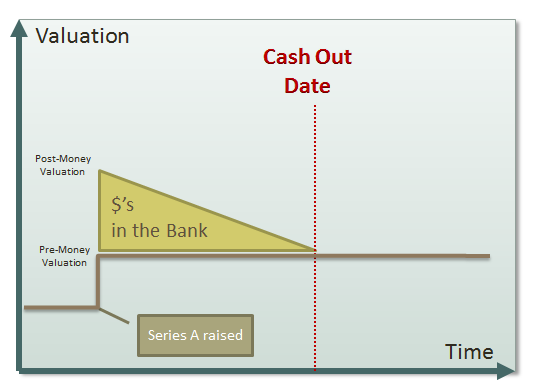
Down rounds happen because you failed to reach the milestones needed to grow into the valuation set by the post-money of your last round. Right after closing that round, your company would have been able to justify that post-money valuation because of the cash sitting in the bank. But as that cash gets spent, your valuation will drop, unless you reach the next milestone (see diagram below).
image

Most of the time down rounds are caused by a failure to execute. That is why it is so important to plan correctly, and then execute according to plan. This seems so obvious that it doesn't need to be stated. However I have personally seen this problem happen over and over again. When speaking with the CEO's after the fact, most would tell you that, in retrospect, they would have lowered their burn rate, hiring fewer people, to give them the runway they needed to get to the next milestone.

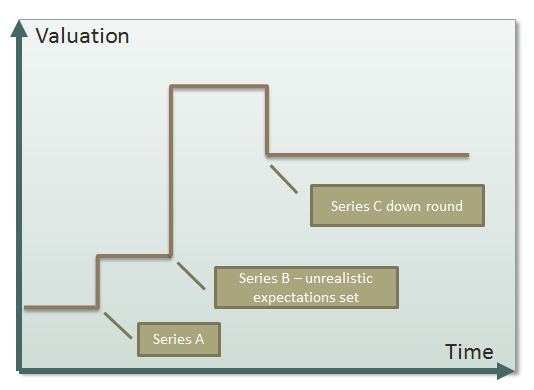
Sometimes down rounds can be caused by raising money at an unrealistic valuation that can't be justified no matter how good the execution. Entrepreneurs who have lived through bubbles understand this well.

It is surprisingly easy to get a high valuation in today's funding environment because of the over supply of investors, and the shortage of supply of really interesting deals. My strong advice to entrepreneurs is to make sure that they are not setting unrealistic expectations for how they will execute, as failure to meet those expectations will come back and bite you in the next round.
image

If you are going to raise money at a crazy high valuation, ideally make sure it will last you through to cash flow breakeven. If you have to raise money again at a lower valuation, the negative company stigma and dilution usually far outweigh the benefits. You would have been better off to take a lower, more realistic, valuation, and be in a position to do an up round next time round.

To quote Andy Verhalen, one of the most experienced partners in our firm: "The best way to optimize for dilution is not to try to optimize a single round, but rather over the long haul (i.e. the whole series of rounds). To do this, you want to space your fund-raising after appropriate milestones (with a cushion) so that valuation increases monotonically. Serious dilution occurs in down rounds, not in slightly under-priced rounds."

Conclusion

My goal was to highlight how startup valuations change based on milestones that significantly de-risk the business. Armed with this information, entrepreneurs should talk to investors to understand how they see the risks and milestones. Then plan and manage their business around achieving desired milestones before hitting their cash out date.

The most important takeaways are:

  1. Take the time to think this through and build a plan.
  2. Make following the plan a very high priority.

I have one final comment: Success at raising money does not equal business success. I have generally found that it is far easier to raise money than it is to get paying customers. If you have just raised a round at a great valuation, don't confuse this with real success in business. That only comes from selling your product to lots of customers!

David Skok is a five time serial entrepreneur turned venture capitalist at Matrix Partners. He blogshere.

Friday, April 1, 2011

Steve Blank: The LeanLaunch Pad at Stanford – Class 3: Value Proposition Hypotheses

The LeanLaunch Pad at Stanford – Class 3: Value Proposition Hypotheses

The Stanford Lean LaunchPad class was an experiment in a new model of teaching startup entrepreneurship. This post is part three. Part one is here, two is here. Syllabus is here.
Week 3 of the class and our teams in our Stanford Lean LaunchPad class were hard at work using Customer Development to get out of the classroom and test the first key hypotheses of their business model: The Value Proposition. (Value Proposition is a ten-dollar phrase describing a company’s product or service. It’s the “what are you building and selling?”)
The Nine Teams Present
This week, our first team up was PersonalLibraries (the team that made software to help researchers manage, share and reference the thousands of papers in their personal libraries.) To test its Value Proposition, the team had face-to-face interviews with 10 current users and non-users from biomedical, neuroscience, psychology and legal fields.
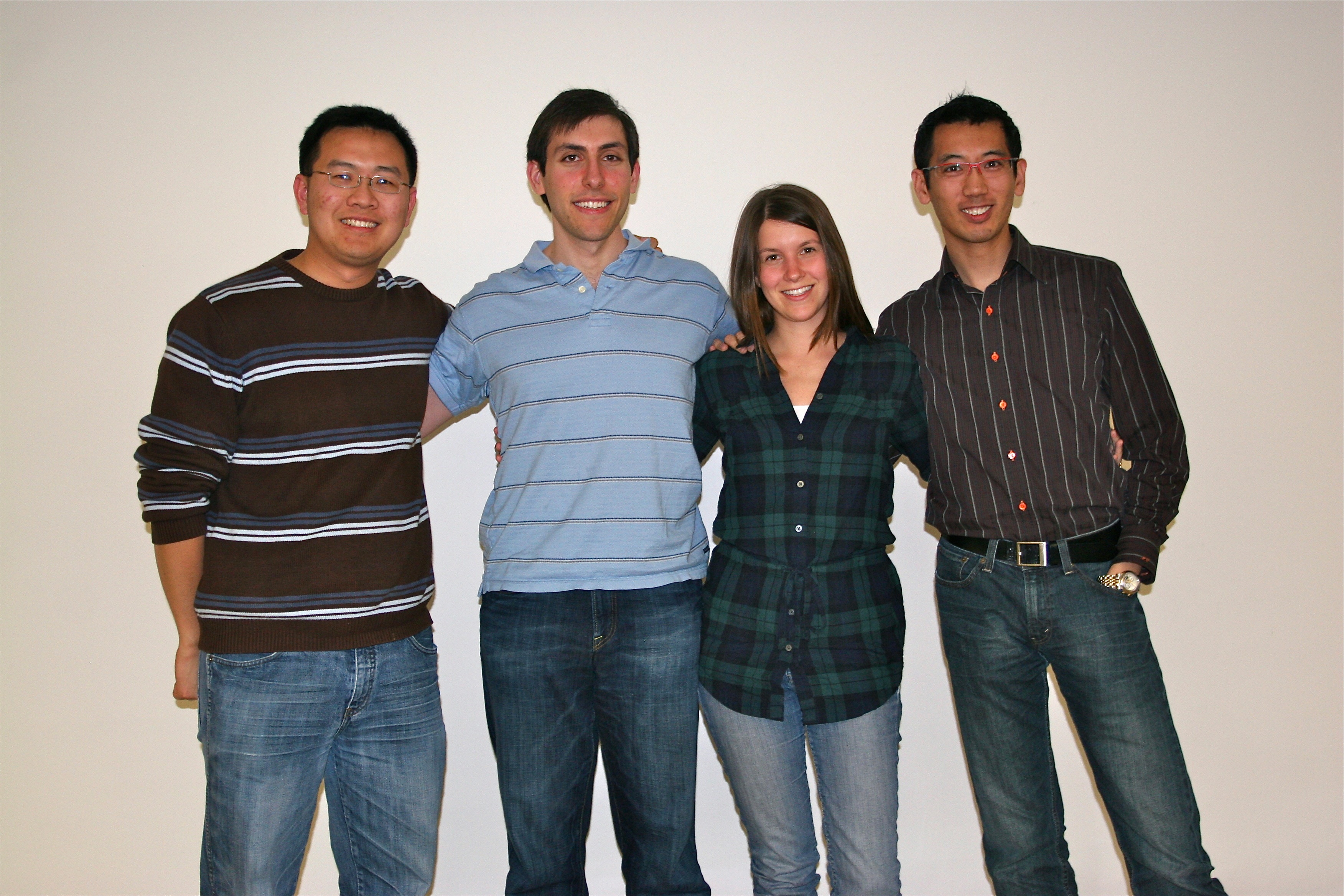
What was cool was they recorded their interviews and posted them as YouTube videos. They did an online survey of 200 existing users (~5% response rate). In addition, they demoed to the paper management research group at the Stanford Intellectual Property Exchange project (a joint project between the Stanford Law School and Computer Science department to help computers understand copyright and create a marketplace for content). They met with their mentors, and refined their messaging pitch by attending a media training workshop one of our mentors held.
If you can’t see the slides above, click here.
In interviewing biomed researchers, they found one unmet need: the ability to cite materials used in experiments. This is necessary so experiments can be accurately reproduced. This was such a pain point, one scientist left a lecture he was attending to find the team and hand them an example of what the citations looked like.
The team left the week excited and wondering – is there an opportunity here to create new value in a citation tool? What if we could help scientists also bulk order supplies for experiments? Could we help manufacturers, as well, to better predict demand for their products, or perhaps to more effectively connect with purchasers?
The feedback from the teaching team was a reminder to see if the users they were talking to constitute a large enough market and had budgets to pay for the software.
Agora Cloud ServicesThe Agora team (offering a cloud computing “unit” that Agora will buy from multiple cloud vendors and create a marketplace for trading) had 7 face-to-face interviews with target customers, and spoke to a potential channel partner as well as two cloud industry technology consultants.
They learned that their hypothesis that large companies would want to lower IT costs by selling their excess computing capacity on a “spot market” didn’t work in the financial services market because of security concerns.  However sellers in the Telecom industries were interested if there was some type of revenue split from selling their own excess capacity.
On the buyers’ side, their hypothesis that there were buyers who were interested in reduced cloud compute infrastructure cost turned out not to be a high priority for most companies. Finally, their assumption that increased procurement flexibility for buying cloud compute cycles would be important turned out to be just a “nice to have,” not a real pain. Most companies were buying Amazon Web Services and were looking for value-added services that simplified their cloud activities.
If you can’t see the slides above, click here.
The Agora team left the week thinking that the questions going forward were:
  • žHow do we get past Amazon as the default cloud computing service provider?
  • How viable is the telecom market as a potential seller of computing cycles?
  • We need to further validate buyer & seller value propositions
  • How do we access the buyers and sellers? What sort of sales structure and salesforce does it require?
  • Who is the main buyer(s) and what are their motivations?
  • Is a buying guide/matching service a superior value proposition to marketplace?
The feedback from the teaching team was a reminder that at times you may have a product in search of a solution.

D.C. VeritasD.C. Veritas, the team that was going to build a low cost, residential wind turbine that average homeowners could afford, wanted to provide a renewable source of energy at affordable price.  They started to work out what features a minimum viable product their value proposition would have and began to cost out the first version. The Wind Turbine Minimum Viable Product would have a: Functioning turbine, Internet feedback system, energy monitoring system and have easy customer installation.
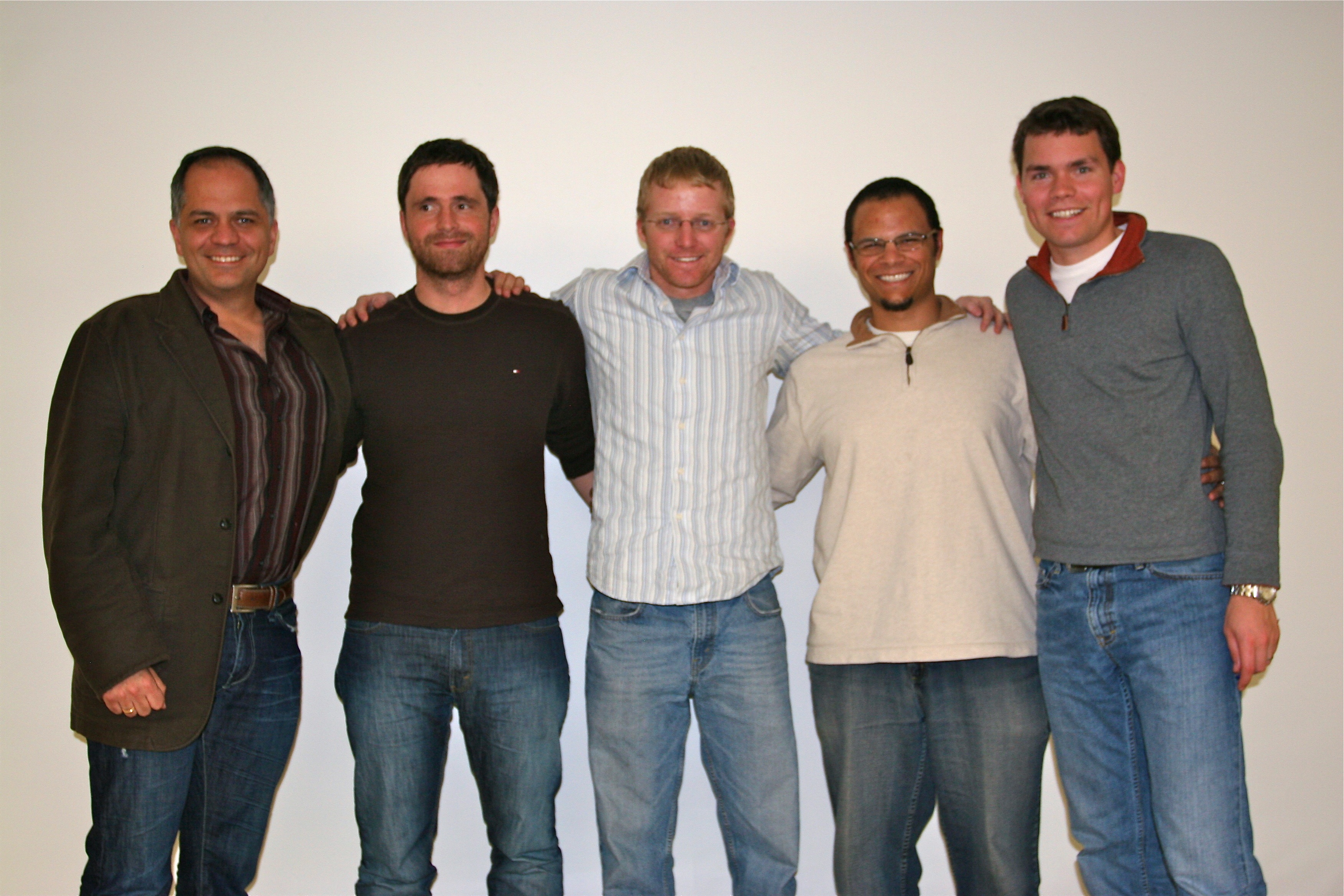
The initial Bill of Material (BOM) of the Wind Turbine Hardware Costs looked like: Inverter (1000W): $500 (plug and play), Generator (1000W): $50-100, Turbine: ~$200, Output Measurement: ~$25, Wiring: $20 = Total Material Cost: ~$800-$850
The team also went to the whiteboard and attempted a first pass at who the archetypical customer(s) might be.

To get customer feedback the team posted its first energy survey here and received 27 responses. In their first attempt at face-to-face customer interviews to test their value proposition and problem hypothesis (would people be interested in a residential wind turbine), they interviewed 13 people at the local Farmer’s Market.
If you can’t see the slide presentation above, click here.
The teaching team offered that out of 13 people they interviewed only 3 were potential customers. Therefore the amount of hard customer data they had collected was quite low and they were making decisions on a very sparse data set. We suggested (with a (2×4) that were really going to have to step up the customer interactions with a greater sense of urgency.The teaching team offered that out of 13 people they interviewed only 3 were potential customers. Therefore the amount of hard customer data they had collected was quite low and they were making decisions on a very sparse data set. We suggested (with a 2×4) that were really going to have to step up the customer interactions with a greater sense of urgency.
Autonomow
The last team up was Autonomow, the robot lawn mower. They were in the middle of trying to answer the question of  “what problem are they solving?” They were no longer sure whether they were an autonomous mowing company or an agricultural weeding company.
They spoke to 6 people with large mowing needs (golf course, Stanford grounds keeper, etc.) They traveled to the Salinas Valley and Bakersfield and interviewed 6 farmers about weeding crops. What they found is that weeding is a huge problem in organic farming. It was incredibly labor intensive and some fields had to be hand-weeded multiple times per year.
They left the week realizing they had a decision to make – were they a  “Mowing or Weeding” company?
If you can’t see the slide above, click here.
Our feedback: could they really build a robot to recognize and kill weeds in the field?
The Week 3 Lecture: Customers
Our lecture this week covered Customers – what/who are they?  We pointed out the difference between a user, influencer, recommender, decision maker, economic buyer and saboteur. We also described the differences between customers in Business-to-business sales versus business-to-consumer sales.  We talked about multi-sided markets and offered that not only are there multiple customers, but each customer segment has their own value proposition and revenue model.
If you can’t see the slide above, click here.
Getting Out of the Building
Five other teams presented after these four. All of them had figured out the game was outside the building, with some were coming up to speed faster than others. A few of the teams ideas still looked pretty shaky as businesses. But the teaching team held our opinions to ourselves, as we’ve learned that you can’t write off any idea too early. Usually the interesting Pivots happens later. The finish line was a ways off. Time would tell where they would all end up.
———
Next week each team test their Customer Segment hypotheses (who are their customers/users/decision makers, etc.) and report the results of face-to-face customer discovery. That will be really interesting
http://steveblank.com/2011/03/25/the-leanlaunch-pad-at-stanford-%e2%80%93-class-3-value-proposition-hypotheses/

Steve Blank: The LeanLaunch Pad at Stanford – Class 2: Business Model Hypotheses

The LeanLaunch Pad at Stanford – Class 2: Business Model Hypotheses

Our new Stanford Lean LaunchPad class was an experiment in a new model of teaching startup entrepreneurship. This post is part two. Part one is here. Syllabus here.
By now the nine teams in our Stanford Lean LaunchPad Class were formed, In the four days between team formation and this class session we tasked them to:
  • Write down their initial hypotheses for the 9 components of their company’s business model (who are the customers? what’s the product? what distribution channel? etc.)
  • Come up with ways to test each of the 9 business model canvas hypotheses
  • Decide what constitutes a pass/fail signal for the test. At what point would you say that your hypotheses wasn’t even close to correct?
  • Consider if their business worth pursuing? (Give us an estimate of market size)
  • Start their team’s blog/wiki/journal to record their progress during for the class
The Nine Teams PresentEach week every team presented a 10 minute summary of what they had done and what they learned that week. As each team presented, the teaching team would ask questions and give suggestions (at times pointed ones) for things the students missed or might want to consider next week. (These presentations counted for 30% of their grade. We graded them on a scale of 1-5, posted our grades and comments to a shared Google doc, and had our Teaching Assistant aggregate the grades and feedback to pass on to the teams.)
Our first team up was Autonomow. Their business was a robot lawn mower. Off to a running start, they not only wrote down their initial business model hypotheses but they immediately got out of the building and began interviewing prospective customers to test their three most critical assumptions in any business:
Value PropositionCustomer Segment and Channel. Their hypotheses when they first left the campus were:
  • Value Proposition:  Labor costs in mowing and weeding applications are significant, and autonomous implementation would solve the problem.
  • Customer Segment: Owners/administrators of large green spaces (golf courses, universities, etc.) would buy an autonomous mower.  Organic farmers would buy if the Return On Investment (ROI) is less than 1 year.
  • Channel: Mowing and agricultural equipment dealers
All teams kept a blog – almost like a diary – to record everything they did. Reading the Autonomow blog for the first week, you could already see their first hypotheses starting to shift: “For mowing applications, we talked to the Stanford Ground Maintenance, Stanford Golf Course supervisor for grass maintenance, a Toro distributor, and an early adopter of an autonomous lawn mower. For weeding applications, we spoke with both small and large farms. In order from smallest (40 acres) to largest (8000+ acres):  Paloutzian Farms, Rainbow Orchards, Rincon Farms, REFCO Farms, White Farms, and Bolthouse Farms.”
“We got some very interesting feedback, and overall interest in both systems,” reported the team. “Both hypotheses (mowing and weeding) passed, but with some reservations (especially from those whose jobs they would replace!)  We also got good feedback from Toro with respect to another hypothesis – selling through distributor vs. selling direct to the consumer.”
The Autonomow team summarized their findings in their first 10 minute, weekly Lesson Learned presentation to the class.
Our feedback: be careful they didn’t make this a robotics science project and instead make sure they spent more time outside the building.
If you can’t see the slide deck above, click here.
Autonomow team members:Jorge Heraud (MS Management, 2011) Business Unit Director, Agriculture, Trimble Navigation, Director of Engineering, Trimble Navigation, MS&E (Stanford), MSEE (Stanford), BSEE (PUCP, Peru)
Lee Redden (MSME Robotics, Jun 2011) Research in haptic devices, autonomous systems and surgical robots, BSME (U Nebraska at Lincoln), Family Farms in Nebraska
Joe Bingold (MBA, Jun 2011) Head of Product Development for Naval Nuclear Propulsion Plant Control Systems, US Navy, MSME (Naval PGS), BSEE (MIT), P.E. in Control SystemsFred Ford (MSME, Mar 2011) Senior Eng for Mechanical Systems on Military Satellites, BS Aerospace Eng (U of Michigan)
Uwe Vogt (MBA, Jun 2011) Technical Director & Co-Owner, Sideo Germany (Sub. Vogt Holding), PhD Mechanical Engineering  (FAU, Germany), MS Engineering (ETH Zurich, Switzerland
The mentors who volunteered to help this team were Sven Strohbad, Ravi Belani and George Zachary.
Personal Libraries
Our next team up was Personal Libraries which proposed to help researchers manage, share and reference the thousands of papers in their personal libraries. “We increase a researcher’s productivity with a personal reference management system that eliminates tedious tasks associated with discovering, organizing and citing their industry readings,” wrote the team. What was unique about this team was that Xu Cui, a Stanford postdoc in Neuroscience, had built the product to use for his own research. By the time he joined the class, the product was being used in over a hundred research organizations including Stanford, Harvard, Pfizer, the National Institute of Health and Peking University. The problem is that the product was free for end users and few Research institutions purchased site licenses. The goal was to figure out whether this product could become a company.
The Personal Libraries core hypotheses were:
  • We solve enough pain for researchers to drive purchase
  • Dollar size of deals is sufficient to be profitable with direct sales strategy
  • The market is large enough for a scalable business
Our feedback was that “free” and “researchers in universities” was often the null set for a profitable business.

If you can’t see the slide above, click here.

Personal Libraries Team MembersAbhishek Bhattacharyya (MSEE, Jun 2011) creator of WT-Ecommerce, an open source engine, Ex-NEC engineer
Xu Cui (Ph.D, Jun 2007 Baylor) Stanford Researcher Neuroscience, postdoc, BS biology from Peking University
Mike Dorsey (MBA/MSE, Jun 2011) B.S. in computer science, environmental engineering and middle east studies from Stanford, Austin College and the American University in Cairo
Becky Nixon (MSE, Jun 2011) BA mathematics and psychology Tulane University Ex-Director, Scion Group,
Ian Tien (MBA, Jun 2011) MS in Computer Science from Cornell, Microsoft Office Engineering Manager for SharePoint, and former product manager for SkyDrive
The mentors who volunteered to help this team were Konstantin Guericke and Bryan Stolle.
The Week 2 Lecture: Value PropositionOur working thesis was not one we shared with the class – we proposed to teach entrepreneurship the way you would teach artists – deep theory coupled with immersive hands-on experience.
Our lecture this week covered Value Proposition – what problem will the customer pay you to solve?  What is the product and service you were offering the customer to solve that problem.
If you can’t see the slide above, click here.
Feeling Good
Seven other teams presented after the first two (we’ll highlight a few more of them in the next posts.) About half way through the teaching team started looking at each other all with the same expression – we may be on to something here.
———
Next week each team tests their value proposition hypotheses (their product/service)  and reports the results of face-to-face customer discovery. Stay tuned
http://steveblank.com/2011/03/15/the-leanlaunch-pad-at-stanford-class-2-business-model-hypotheses/

Steve Blank: A New Way to Teach Entrepreneurship – The Lean LaunchPad at Stanford: Class 1

A New Way to Teach Entrepreneurship – The Lean LaunchPad at Stanford: Class 1

For the past three months, we’ve run an experiment in teaching entrepreneurship.
In January, we introduced a new graduate course at Stanford called the Lean LaunchPad. It was designed to bring together many of the new approaches to building a successful startup – customer development, agile development, business model generation and pivots.
We thought it would be interesting to share the week-by-week progress of how the class actually turned out. This post is part one.
A New Way to Teach EntrepreneurshipAs the students filed into the classroom, my entrepreneurial reality distortion field began to weaken. What if I was wrong? Could we even could find 40 Stanford graduate students interested in being guinea pigs for this new class? Would anyone even show up?  Even if they did, what if the assumption – that we had developed a better approach to teaching entrepreneurship – was simply mistaken?
We were positing that 20 years of teaching “how to write a business plan” might be obsolete. Startups, are not about executing a plan where the product, customers, channel are known. Startups are in fact only temporary organizations, organized to search–not execute–for a scalable and repeatable business model.
We were going to toss teaching the business plan aside and try to teach engineering students a completely new approach to start companies – one which combines customer development, agile development, business models and pivots. (The slides below and the syllabus here describe the details of the class.)
Get Out of the Building and test the Business Model
While we were going to teach theory and frameworks, these students were going to get a hands-on experience in how to start a new company. Over the quarter, teams of students would put the theory to work, using these tools to get out of the building and talk to customer/partners, etc. to get hard-earned information. (The purpose of getting out of the building is not to verify a financial model but to hypothesize and verify the entire business model. It’s a subtle shift but a big idea with tremendous changes in the end result.)
Team Autonomow: Weeding Robot Prototype on a Farm
We were going to teach entrepreneurship like you teach artists – combining theory – with intensive hands-on practice. And we were assuming that this approach would work for any type of startup – hardware, medical devices, etc. – not just web-based startups.
If we were right, we’d see the results in their final presentations – after 8 weeks of class the information/learning density in the those presentations should be really high. In fact they would be dramatically different than any other teaching method.
But we could be wrong.
While I had managed to persuade two great VC’s to teach the class with me (Jon Feiber and Ann Miura-ko), what if I was wasting their time? And worse, what if I was going to squander the time of my students?
I put on my best game face and watched the seats fill up in the classroom.
MentorsA few weeks before the Stanford class began, the teaching team went through their Rolodexes and invited entrepreneurs and VCs to volunteer as coaches/mentors for the class’s teams. (Privately I feared we might have more mentors than students.) An hour before this first class, we gathered these 30 impressive mentors to brief them and answer questions they might have after reading the mentor guide which outlined the course goals and mentor responsibilities.
As the official start time of the first class drew near, I began to wonder if we had the wrong classroom. The room had filled up with close to a 100 students who wanted to get in. When I realized they were all for our class, I could start to relax. OK, somehow we got them interested. Lets see if we can keep them. And better, lets see if we can teach them something new.
The First ClassThe Lean LaunchPad class was scheduled to meet for three hours once a week. Given Stanford’s 10 week quarters, we planned for eight weeks of lecture and the last two weeks for team final presentations. Our time in class would be relatively straightforward. Every week, each team would give a 10-minute presentation summarizing the “lessons learned” from getting out of the building. When all the teams were finished the teaching team lectured on one of the 9 parts of the business model diagram. The first class was an introduction to the concepts of business model design and customer development.
http://www.slideshare.net/sblank/stanford-e245-lean-launchpad-winter-10-session-01-course-overview-rev-4
The most interesting part of the class would happen outside the classroom when each team spent 50-80 hours a week testing their business model hypotheses by talking to customers and partners and (in the case of web-based businesses) building their product.
Selection, Mixer and Speed DatingAfter the first class, our  teaching team met over pizza and read each of the 100 or so student applications. Two-thirds of the interested students were from the engineering school; the other third were from the business school. And the engineers were not just computer science majors, but in electrical, mechanical, aerospace, environmental, civil and chemical engineering. Some came to the class with an idea for a startup burning brightly in their heads.  Some of those applied as teams. Others came as individuals, most with no specific idea at all.
We wanted to make sure that every student who took the class had at a minimum declared a passion and commitment to startups. (We’ll see later that saying it isn’t the same as doing it.) We tried to weed out those that were unsure why they were there as well as those trying to build yet another fad of the week web site. We made clear that this class wasn’t an incubator. Our goal was to provide students with a methodology and set of tools that would last a lifetime – not to fund their first round. That night we posted the list of the students who were accepted into the class.
The next day, the teaching team held a mandatory “speed-dating” event with the newly formed teams. Each team gave each professor a three-minute elevator pitch for their idea, and we let them know if it was good enough for the class. A few we thought were non-starters were sold by teams passionate enough to convince us to let them go forward with their ideas. (The irony is that one of the key tenets of this class is that startups end up as profitable companies only after they learn, discover, iterate and Pivot past their initial idea.) I enjoyed hearing the religious zeal of some of these early pitches.
The TeamsBy the beginning of second session the students had become nine teams with an amazing array of business ideas. Here is a brief summary of each.
Agora isan affordable “one-stop shop” for cloud computing needs. Intended for cloud infrastructure service providers, enterprises with spare capacity in their private clouds, startups, companies doing image and video processing, and others. Agora’s selling points are its ability to reduce users’ IT infrastructure cost and enhance revenue for service providers.
Autonomow is an autonomous large-scale mowing intended to be a money-saving tool for use on athletic fields, golf courses, municipal parks, and along highways and waterways. The product would leverage GPS and laser-based technologies and could be used on existing mower or farm equipment or built into new units.
BlinkTraffic will empower mobile users in developing markets (Jakarta, Sao Paolo, Delhi, etc.) to make informed travel decisions by providing them with real-time traffic conditions. By aggregating user-generated speed and location data, Blink will provide instantaneously generated traffic-enabled maps, optimal routing, estimated time-to-arrival and predictive itinerary services to personal and corporate users.
D.C. Veritas is making a low cost, residential wind turbine. The goal is to sell a renewable source of energy at an affordable price for backyard installation. The key assumptions are: offering not just a product, but a complete service (installation, rebates, and financing when necessary,) reduce the manufacturing cost of current wind turbines, provide home owners with a cool and sustainable symbol (achieving “Prius” status.)
JointBuy is an online platform that allows buyers to purchase products or services at a cheaper price by giving sellers opportunities to sell them in bulk. Unlike Groupon which offers one product deal per day chosen based on the customer’s location. JointBuy allows buyers to start a new deal on any available product and share the idea with others through existing social networking sites. It also allows sellers to place bids according to the size of the deal.  
MammOptics is developing an instrument that can be used for noninvasive breast cancer screening. It uses optical spectroscopy to analyze the physiological content of cells and report back abnormalities. It will be an improvement over mammography by detecting abnormal cells in an early stage, is radiation-free, and is 2-5 times less expensive than mammographs. We will sell the product directly to hospitals and private doctors.
Personal Libraries is a personal reference management system streamlinig the processes for discovering, organizing and citing researchers’ industry readings. The idea came from seeing the difficulty biomed researchers have had in citing the materials used in experiments. The Personal Libraries business model is built on the belief that researchers are overloaded with wasted energy and inefficiency and would welcome a product that eliminates the tedious tasks associated with their work.
PowerBlocks makes a line of modular lighting. Imagine a floor lamp split into a few components (the base, a mid-section, the top light piece). What would you do if wanted to make that lamp taller or shorter? Or change the top light from a torch-style to an LED-lamp? Or add a power plug in the middle? Or a USB port? Or a speaker? “PowerBlocks” modular lighting is “floor-lamp meets Legos” but much more high-end. Customers can choose components to create the exact product that fit their needs.
Voci.us is an ad-supported, web-based comment platform for daily news content. Real-time conversations and dynamic curation of news stories empowers people to expand their social networks and personal expertise about topics important to them. This addresses three problems vexing the news industry: inadequate online community engagement, poor topical search capacity on news sites, and scarcity of targeted online advertising niches.
While I was happy with how the class began, the million dollar question was still on the table – is teaching entrepreneurship with business model design and customer development better than having the students write business plans? Would we have to wait 8 more weeks until their final presentation to tell? Would we signs of success early?  Or was the business model/customer development framework just smoke, mirror and B.S.?
The Adventure BeginsWe’re going to follow the adventures of a few of the teams week by week as they progressed through the class, (and we’ll share the teams weekly “lessons learned,” as well as our class lecture slides.
The goal for the teams for next week were:
  • Write down their hypotheses for each of the 9 parts of the business model.
  • Come up with ways to test:
    • what are each of the 9 business model hypotheses?
    • is their business worth pursuing (market size)
  • Come up with what constitutes a pass/fail signal for the test (e.g. at what point would you say that your hypotheses wasn’t even close to correct)?
  • Start their blog/wiki/journal for the class
http://steveblank.com/2011/03/08/a-new-way-to-teach-entrepreneurship-the-lean-launchpad-at-stanford-class-1/?blogsub=confirming#subscribe-blog